
Updated July 2026
Short answer: you can only use a microSD card in a laptop “without an adapter” if the laptop has a dedicated microSD-size slot — and many thin laptops do. If your laptop has the bigger full-size SD slot, do not push a bare microSD card into it: the card is smaller than the slot, it will slide past the reader contacts, and it very often gets stuck inside the chassis. The marketing never mentions that; the repair forums are full of it.
Here’s how to tell which slot you have, four legitimate adapter-free ways to get the files across, and — because you may be reading this too late — how to get a microSD card back out of a slot it shouldn’t have gone into.
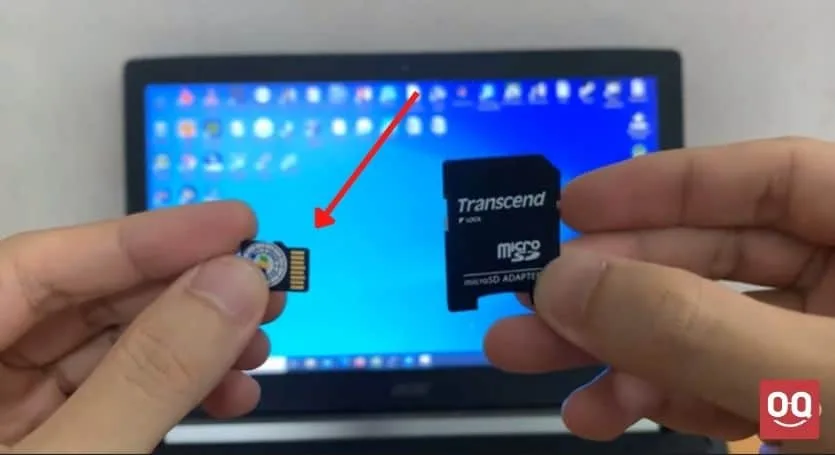
Worth saying plainly: the SD-shaped adapter this article works around is the cheapest fix there is — it costs a few dollars and very often ships free inside the microSD card\’s own packaging. Check the box before buying anything. Everything below is for when you genuinely don\’t have one.
Step 1: Check which card slot your laptop actually has
Look at the slot on the side of your laptop and compare it to the cards:
- microSD slot — about 15 mm wide, barely wider than your fingernail. The card clicks in flush or nearly flush. Common on ultrabooks and 2-in-1s. If you have this, you’re done: push the card in label-up until it clicks. No adapter was ever needed.
- Full-size SD slot — about 25 mm wide, the size of a postage stamp. This slot expects the big card (or a microSD sitting inside an SD-shaped adapter). A bare microSD in this slot will not connect and can disappear inside.
- No slot at all — increasingly common on thin laptops. Skip to the phone method below.
4 ways to read a microSD card without the SD adapter
1. Use your phone as the card reader (free, works today)
If the microSD card came from your phone — or fits in it — you already own a card reader. Put the card in the phone, connect the phone to the laptop with its charging cable, and on the phone choose File transfer / USB mode (MTP) from the notification that appears. The card shows up on the laptop like a USB drive. This is the fastest zero-cost route for a one-off transfer.
2. Use a camera, dashcam, or game console the same way
Any device that takes the microSD and has a USB cable can act as a reader: digital cameras, dashcams, a Nintendo Switch in file-transfer mode, even some drones. Insert the card, connect via USB, pick “mass storage” or “file transfer” on the device if it asks.
3. Transfer wirelessly (no cable at all)
For a handful of files, skip hardware entirely: with the card in your phone, upload to Google Drive/OneDrive and download on the laptop, or use Windows Nearby Sharing / Apple AirDrop-style transfer (Android’s Quick Share works on Windows PCs). Slow for big video folders, painless for documents and photos.
4. Buy a USB microSD reader once, never think about this again
A USB card reader is not the same thing as the SD-shaped adapter this article’s title is avoiding — it plugs into a normal USB-A or USB-C port and takes the microSD directly. They cost about as much as a coffee, and the USB-C ones also work with phones and tablets. If you move files more than once a month, this is the honest answer. See USB microSD readers on Amazon.
What NOT to do
- Don’t insert a bare microSD into a full-size SD slot. It won’t read, and retrieval can mean opening the laptop.
- Don’t force any card. SD cards are keyed — if it doesn’t slide in easily, it’s upside down or the wrong size.
- Don’t wiggle a stuck card with metal tweezers while the laptop is on. Power off first; the slot has live contacts.
MicroSD stuck inside the laptop? Do this
- Power off and unplug the laptop first.
- Gravity + tap: hold the laptop with the slot facing down and give the chassis a few firm taps with your palm. Small cards often drop back to the slot mouth.
- Grip it: if you can see the card edge, pull it out with plastic tweezers or fold a strip of strong tape over a toothpick, press it against the card face, and draw it out.
- Still inside the chassis? The card has slipped past the reader. Opening the bottom panel is usually simple on laptops with visible screws — or let a repair shop do a 10-minute job cheaply. Don’t fish blindly with metal objects.
FAQ
Can I put a microSD card directly into a laptop?
Only if the laptop has a microSD-size slot (~15 mm wide, card fits snugly and clicks). If the slot is the wider full-size SD type, the bare card will not connect and can get lost inside.
Why does my laptop not read the microSD card in its microSD slot?
Push until it clicks and sits flush — half-inserted cards don’t read. If it still fails, test the card in a phone: if the phone reads it, the laptop’s reader or driver is the problem (check Device Manager on Windows); if the phone can’t read it either, the card is likely dead or needs formatting.
Is a USB card reader better than the SD adapter?
For laptops without any card slot, it’s the only hardware option — and USB 3 readers are usually faster than old built-in SD slots. The SD-shaped adapter only helps if you have a full-size SD slot to put it in.
Does using my phone as a reader damage the card?
No. MTP file transfer through the phone is exactly how the card is designed to be used. Just use “eject”/safe-removal before unplugging mid-transfer.
Related: how to get more ports on a laptop, how to tell if a laptop has water damage, and the rest of our laptop troubleshooting guides.