
Updated July 2026
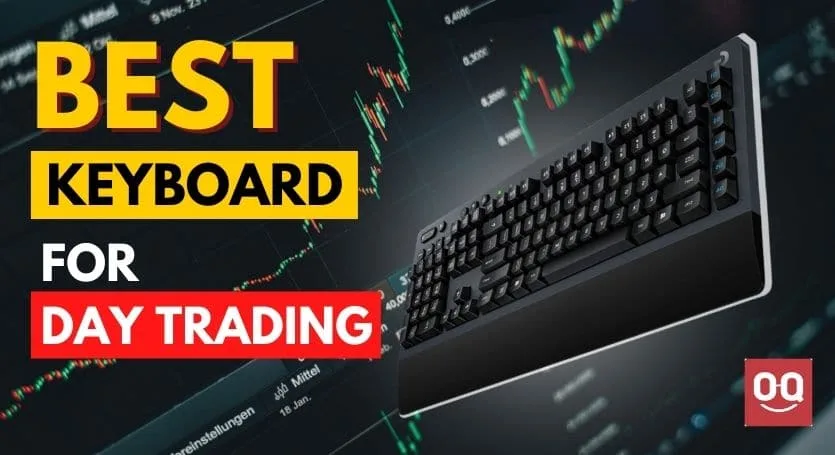
The best keyboard for day trading is the Keychron Q6 Pro — a wired, fully programmable board where every one of its 108 keys can hold an order hotkey via QMK/VIA, with full n-key rollover so a panicked three-key combo never drops a stroke. The spec that decides this purchase isn’t speed. It’s programmability plus wired reliability.
Because here’s the myth every trading-keyboard round-up sells: that traders need “gaming speed” — optical switches, 8,000 Hz polling, sub-millisecond actuation. Let’s be honest about the numbers. A fast switch saves you maybe 5 ms over a standard one. Your order travels through your platform, your broker, and an exchange gateway — a round trip measured in tens of milliseconds at best, and your human reaction time is ~200 ms on a good day. The switch is not your bottleneck and never will be. What actually loses traders money is (a) fumbling a multi-key order combo because their hotkeys live on awkward default bindings, and (b) a wireless keyboard hiccuping — a reconnect, a dead battery, one dropped keystroke — while a position moves against them. That second one is the real horror story, and it’s why opinion here is unambiguous: trade wired.
The specs that actually matter for a trading keyboard
Programmable keys, ideally full remapping. Buy limit, sell limit, flatten position, cancel all — these belong on dedicated keys your fingers find without looking. Open-source firmware (QMK/VIA) beats vendor software because your mappings live on the keyboard itself, not in an app that might not launch on the morning it matters.
Wired connection. A cable has no battery, no interference, no reconnect delay. For an instrument you use to move money, this isn’t nostalgia — it’s risk management.
Full n-key rollover. Modifier-heavy order combos (Ctrl+Shift+key) must register every time. Any board that can’t is disqualified — that failure mode is keyboard ghosting, and you don’t want to learn the term from a bad fill.
Comfort for the other seven hours. You’ll spend far more time journaling and scanning than executing. Tactile switches around 45–55 g and decent stabilisers matter more than any speed spec. (Mechanical boards also simply last — switches are rated 50–100 million presses; see how long mechanical keyboards last.)
1. Keychron Q6 Pro — buy it (best for most traders)
A full-size, gasket-mounted aluminium board with QMK/VIA support: map order hotkeys to any key, build layers (tap Fn and your F-row becomes a second bank of order keys), and store it all on-board. Hot-swap sockets mean you tune switch feel without replacing the board. Use it wired — it supports Bluetooth, but you now know better.
Buy it if: you execute via hotkeys and want your whole layout programmable, on hardware built to survive years of daily sessions.
Skip it if: you want dedicated extra macro keys you can label — that’s the K100 below.
Check Keychron Q6 Pro on Amazon
2. Corsair K100 RGB — it depends (dedicated macro columns)
Six dedicated macro keys in their own left-hand column — physically separate from the typing cluster, so a flatten-position key can never be fat-fingered as a letter. That separation is genuinely valuable for order entry. The catch: macros live in Corsair’s iCUE software, which is heavier and less dependable than on-board QMK, and you’re paying flagship money partly for RGB theatre you don’t need.
Buy it if: you want labelled, physically separate order keys and accept vendor software.
Skip it if: you’d rather have firmware-level mappings that work on any machine — the Q6 Pro wins there.
Check Corsair K100 RGB on Amazon
3. Logitech G815 — it depends (low-profile with G-keys)
Five dedicated G-keys plus low-profile mechanical switches in a slim wired chassis. If full-height mechanicals tire your hands, the ~2.7 mm-travel switches are the comfortable middle ground, and the G-keys handle a core set of order hotkeys through G HUB. Fewer macro keys than the K100, less programmability than QMK.
Buy it if: you prefer low-profile typing and need a handful of dedicated order keys.
Skip it if: your hotkey list runs past five — you’ll outgrow it.
4. Keychron V6 Max (wired mode) — buy it (budget QMK pick)
Nearly everything that makes the Q6 Pro right for trading — full-size layout, QMK/VIA, hot-swap, full NKRO — in a plastic case at roughly half the price. This is the “most people overbuy” pick: the aluminium case buys feel and acoustics, not function. Your order hotkeys work identically.
Buy it if: you want full programmability at the lowest sensible price. (More like this in our budget mechanical keyboards guide.)
Skip it if: you sit at this desk 8 hours a day and the premium build is worth it to you — that’s the honest case for the Q6 Pro.
Check Keychron V6 Max on Amazon
5. Elgato Stream Deck MK.2 — buy it (not a keyboard — what many traders actually want)
Honest recommendation: many traders asking for a “trading keyboard” actually want this — 15 LCD keys, each showing a custom icon and firing any macro or hotkey. “BUY 100”, “SELL 100”, “FLATTEN”, “CANCEL ALL” as labelled, glanceable buttons that can’t be confused with typing keys. Keep whatever keyboard you already love and put order entry on its own device. Wired, naturally.
Buy it if: you want visual, dedicated, mistake-proof order buttons alongside your current board.
Skip it if: you need tactile blind operation — flat LCD keys give less feedback than real switches under stress.
Check Elgato Stream Deck MK.2 on Amazon
Comparison at a glance
| Pick | Best for | Why it wins | The catch |
|---|---|---|---|
| Keychron Q6 Pro | Most hotkey traders | Full QMK/VIA remapping, on-board layers, premium build | No dedicated labelled macro column |
| Corsair K100 RGB | Dedicated macro keys | Six separate macro keys, can’t fat-finger | iCUE software dependency; RGB tax |
| Logitech G815 | Low-profile fans | Slim wired board with five G-keys | Only five macro keys |
| Keychron V6 Max | Budget programmability | Same QMK/VIA function, half the price | Plastic case, plainer acoustics |
| Elgato Stream Deck MK.2 | Visual order entry | 15 labelled LCD buttons for orders | Not a keyboard; flat keys, less tactile |
A trading desk is more than the board — our desk setup guides and the rest of the keyboard section cover monitors arms, mice, and the rest. If your work leans spreadsheets more than order tickets, the spec list changes — see our data entry keyboard guide.
FAQ
Do day traders need a gaming keyboard?
Not for speed. A faster switch saves single-digit milliseconds while human reaction time is around 200 ms and order routing adds tens more — the switch is never the bottleneck. Gaming boards earn their place only through programmable macro keys and n-key rollover, which is why a QMK board like the Keychron Q6 Pro beats most “fast” gaming keyboards for trading.
Is a wireless keyboard OK for day trading?
We advise against it. A reconnect delay, interference, or a dead battery during an open position is a small-probability, high-cost failure — exactly the kind traders are supposed to eliminate. A wired connection has no battery and no radio link. Use wireless for the couch, not the trading desk.
What are the most useful trading hotkeys to program?
Start with five: buy at bid/limit, sell at ask/limit, flatten position, cancel all orders, and a position-size preset. Put them on dedicated keys or a layer your hand finds without looking. Flatten and cancel-all matter most — they’re the ones you press under stress.
Is a Stream Deck good for trading?
Yes, as a companion device. The Elgato Stream Deck gives you labelled LCD buttons for order commands, which prevents mis-keying and works with any keyboard. Its weakness is tactility — the flat keys give less physical confirmation than mechanical switches, so some traders keep critical keys on the keyboard and use the deck for everything else.