
Updated July 2026
Short answer: if the marks are oily smudges transferred from the keys, a dry microfiber cloth — then one barely dampened with distilled water — removes them completely. If straight lines remain after cleaning, the screen’s anti-reflective coating has been physically worn by key contact, and no cleaner will bring that back. Knowing which type you have before you scrub matters, because the most common “fix” people reach for — strong alcohol or glass cleaner — is exactly what strips the coating and turns a removable smudge into a permanent stripe.
First, diagnose: smudge or coating damage?
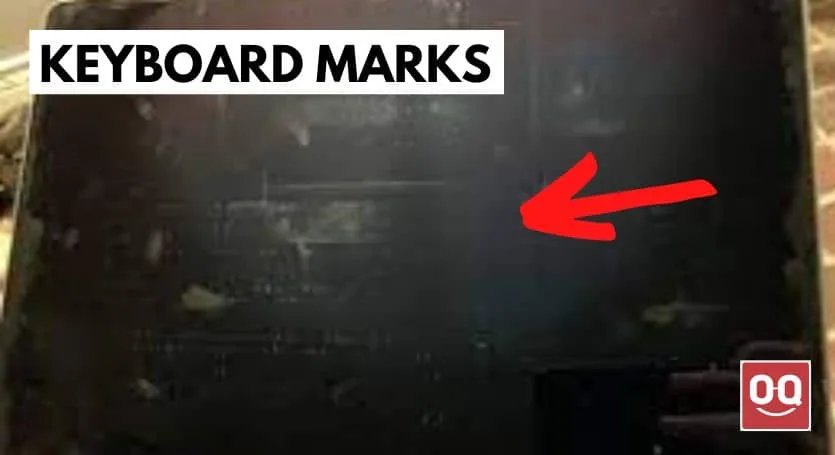
Turn the screen off (marks show best on black) and look at the key-shaped rows:
- Greasy, slightly rainbow-tinted, smears when touched → oil and skin residue from the keycaps. Cleanable. Continue below.
- Matte, etched-looking lines that don’t change when wiped → the coating itself is abraded. Cleaning won’t help; see the last section for your options.
- Bright spots or blotches that show when the screen is ON → that’s pressure damage to the panel, a different problem — see our guide to pressure marks on laptop screens.
Removing keyboard smudges: the safe 5-step method
- Power off, unplug, and let the screen cool. A warm panel evaporates liquid too fast and streaks; a live one makes drips risky.
- Dry pass first. Wipe gently with a clean, dry microfiber cloth in one direction — not circles, which grind any grit around. This alone clears light marks.
- Damp pass. Mist the cloth (never the screen) with distilled water — tap water leaves mineral spots — and wipe with light pressure. Fingertip pressure, no more: LCD panels are the most pressure-sensitive part of the laptop.
- Stubborn grease only: a 50/50 mix of distilled water and 70% isopropyl alcohol, again on the cloth. This is the strongest thing that belongs near a laptop screen. Skip “screen cleaning” sprays with ammonia or ethanol, all window cleaners, and anything acetone — manufacturers including Dell and Apple explicitly warn these strip anti-glare coatings.
- Dry-buff and let it air a minute before closing the lid or powering on.
A basic two-pack of microfiber cloths is the only equipment this job needs — microfiber cloths on Amazon — and the same cloth handles your phone and monitor.
Why the marks keep coming back (and how to stop them)
Keyboard marks are a clearance problem: thin lids flex until the keycaps physically touch the glass, and every hour of typing loads the caps with skin oil that then prints onto the panel. Three habits break the cycle:
- Clean the keys, not just the screen. The screen is only the stamp pad’s victim — degrease the caps occasionally (our guide to cleaning an oily keyboard covers it in five minutes).
- Put a thin microfiber sheet on the keyboard before closing the lid. Many laptops ship with one for exactly this reason; any thin cloth cut to size works. Thick covers can stress the hinges — thin is the point. (Whether silicone keyboard covers are worth it is a separate question — they protect the keys, but a closed lid can press them into the screen even harder.)
- Pack the laptop flat, screw-side out. A bag that presses on the center of the lid is what closes the keycap-to-glass gap. Avoid stacking books or chargers against the lid.
If the marks are permanent coating wear
Once the anti-reflective layer is abraded, your honest options are: live with it (it’s invisible with the screen on bright content), have the anti-glare coating professionally removed from the whole panel (turns the screen glossy — a common fix on older MacBooks), apply a matte screen protector film to mask the texture difference, or replace the panel. Panel replacement is routine and often cheaper than people expect on mainstream laptops; get a quote before writing the screen off.
FAQ
Can I use alcohol wipes on my laptop screen?
Only diluted: 70% isopropyl mixed 50/50 with distilled water, applied to a cloth, is the accepted upper limit. Straight alcohol, ethanol wipes, and window cleaners can strip anti-glare coatings permanently.
Why does my laptop screen have lines exactly matching the keyboard?
Lid flex presses the keycaps against the glass, transferring key-shaped oil deposits — and over time physically polishing the coating in those spots. Smudges wipe off; polished coating doesn’t.
Do keyboard marks mean my screen is damaged?
Usually not — if the mark smears or fades when wiped, it’s surface residue. It’s damage only if a matte etched line survives a proper clean, or if bright blotches show on a lit screen (pressure damage).
What removes keyboard marks that won’t come off?
Nothing safely — if the 50/50 isopropyl pass didn’t remove it, the mark is in the coating, not on it. Stronger chemicals only remove more coating. Mask it with a matte protector film or replace the panel.
More screen care: removing scratches from a laptop touchpad and all our laptop troubleshooting guides.